

Our Baking Products


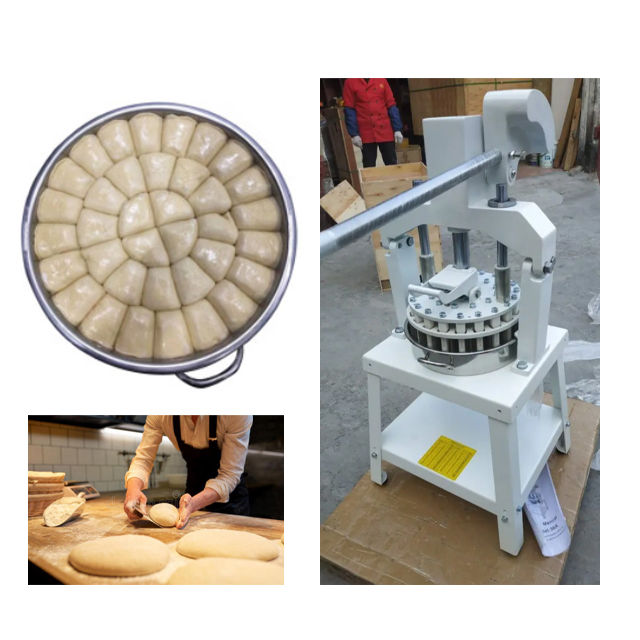
36PCS Manual Dough Ball Dividing Cutting Machine for Bakery
Model:
Manual 36

POWER
0.75KW
380V/220V
VOLTAGE

75 KG
N.Weight

30-120 G/PCS
Capacity

Electric
Energy

Specification
Power source
Electric
Shipping Port
Weight
Material
Stainless Steel
530*460*1620 MM
Functions
Size
Capacity
Certifications
CE/SABS/GSO/ISO
Made in China
Place of Production
Price
Guangzhou China
75 KG
36 PCS/Time
30-120 G/PCS
$500-$16,000
Description
Commercial Manual Dough Dividing Machine
If you are still cutting dough by hand, the problem is not speed. It is inconsistent. A manual dough divider gives you repeatable portions with a simple press-cut cycle, without motors, programming, or voltage concerns. It is a practical upgrade for bakeries, pizza shops, cafes, school kitchens, and small production rooms that want cleaner portion control with minimal investment.
What this machine does (and what it does not)
It divides one dough batch into equal portions using a cutting grid.
It reduces manual cutting time and improves portion consistency.
It does not “create” weight accuracy by itself. True weight accuracy comes from scaling the dough batch correctly before dividing.
Typical applications
Pizza dough portions for a consistent pizza base size
Bun and roll dough portioning for uniform bake and pack
Small bread rolls and snack breads in central kitchens
Pre-portioning before rounding, intermediate proofing, and final shaping
Different model comparison
Manual dough divider
Best for: startups, small shops, low capex upgrades, unstable electricity
Strengths: no power, simple, low maintenance
Trade-off: throughput depends on operator speed and correct scaling
Hydraulic dough divider
Best for: higher batch volume and more consistent pressing force
Strengths: easier pressing, more stable output for frequent cycles
Trade-off: higher cost, heavier, needs power and hydraulic system upkeep
Semi-automatic divider-rounder
Best for: operations that need dividing plus rounding in one step (especially buns and pizza balls)
Strengths: speed and labor reduction, more uniform dough balls
Trade-off: higher cost and footprint than manual
Volumetric divider (continuous output)
Best for: very high output lines where portioning becomes a production line process
Strengths: very high throughput, integrates with rounders and proofers
Trade-off: higher complexity, needs correct dough condition control
How a manual dough divider works
Scale your dough batch: Weigh the total dough to match your target piece weight times the number of portions.
Rest the dough: Short bench rest helps the dough relax so the cut is cleaner.
Load the dough into the pan or chamber: Light flouring is usually enough for sticky dough.
Press to pre-form: The top plate compresses the dough to an even thickness.
Press to cut: The stainless cutting grid splits the dough into equal pieces.
Release and remove: Lift out portions for rounding, proofing, or direct panning.
Key advantages for commercial buyers
No electricity required
Ideal for locations with unstable power, mobile kitchens, or low-energy operations.
Fast training, low operator risk
New staff can learn the press-cut cycle quickly. Consistency is easier to maintain than knife cutting.
Portion consistency that helps the downstream
Uniform pieces proof more evenly and bake more evenly, which helps quality control and reduces rework.
Compact and shipping-friendly
Manual dividers are typically simpler to ship and install than hydraulic or fully automatic dividers.
Food-contact design mindset
A good manual divider focuses on smooth food-contact surfaces, removable pans, and a cutting grid that is easy to rinse and wipe.
Product Image



What to confirm before you choose a model (buyer checklist)
To avoid buying the wrong divider, confirm these items with your supplier:
Portion count needed per cycle (common choices are 18, 20, 30, 36)
Target dough piece weight range (grams per piece)
Total dough capacity per batch (kg per cycle)
Dough type: pizza, bun, soft roll, enriched dough, high hydration dough
Pan or chamber size and whether an extra pan is included
Stand type: tabletop only, or with a heavy-duty stand
Your workflow: divider only, or divider plus rounder
How this works with other bakery equipment (workflow examples)
Small bakery bun line
Spiral mixer or planetary mixer -> bench rest -> manual divider -> dough rounder (optional) -> proofer -> deck oven or convection oven
Pizza shop portioning workflow
Spiral mixer -> bench rest -> manual divider -> quick rounding by hand or rounder -> dough boxes -> retarder or chiller -> stretching and baking
Central kitchen batch prep
Mixer -> manual divider -> intermediate proofing -> moulder or sheeter (for certain products) -> tray loading -> baking.
If you tell the supplier your daily output target and product mix, you can match the divider to the real bottleneck (portioning speed, labor, or consistency).
Common questions buyers ask
How do I control the dough piece weight?
You control it by scaling the total dough batch correctly before dividing. If you want 36 pieces at 80g each, your batch should be 2,880g plus a small allowance for handling loss.
Will it work for sticky dough?
It can, but sticky dough needs correct bench flouring, proper rest time, and clean cutting surfaces. Extremely wet dough is better handled with a system designed for that dough condition.
Is a manual divider better than “just cutting by hand”?
Yes, when you care about consistency, proofing uniformity, and staff time. Hand cutting looks cheap until you count waste, rework, and quality variation.
When should I upgrade from manual to hydraulic or automatic?
Upgrade when portioning becomes a daily bottleneck, when you want more stable cycle force, or when you need dividing plus rounding at higher speed.
Suggested on-page keywords to naturally include (no stuffing)
commercial manual dough divider, manual dough dividing machine, hand dough divider for bakery, pizza dough divider, bun dough divider, 36 division manual dough divider, bakery dough portioning machine, dough divider cutter
More Information


