Retail Bakery vs Wholesale Supply vs Central Kitchen: How the Equipment Stack Changes
- Kian Huang
- 3 minutes ago
- 11 min read
Many bakery buyers start by asking, “What equipment do I need to make bread, cakes, pastries, or pizza?”
That question is not wrong, but it is incomplete.
The same product can need a very different equipment stack depending on the business model. A retail bakery, a wholesale bakery supplier, and a central kitchen may all produce bread, but their production rhythm, labor structure, storage needs, and capacity logic are not the same.
The better question is:
How will this bakery produce, sell, store, and deliver products every day?
That answer decides the real equipment plan.
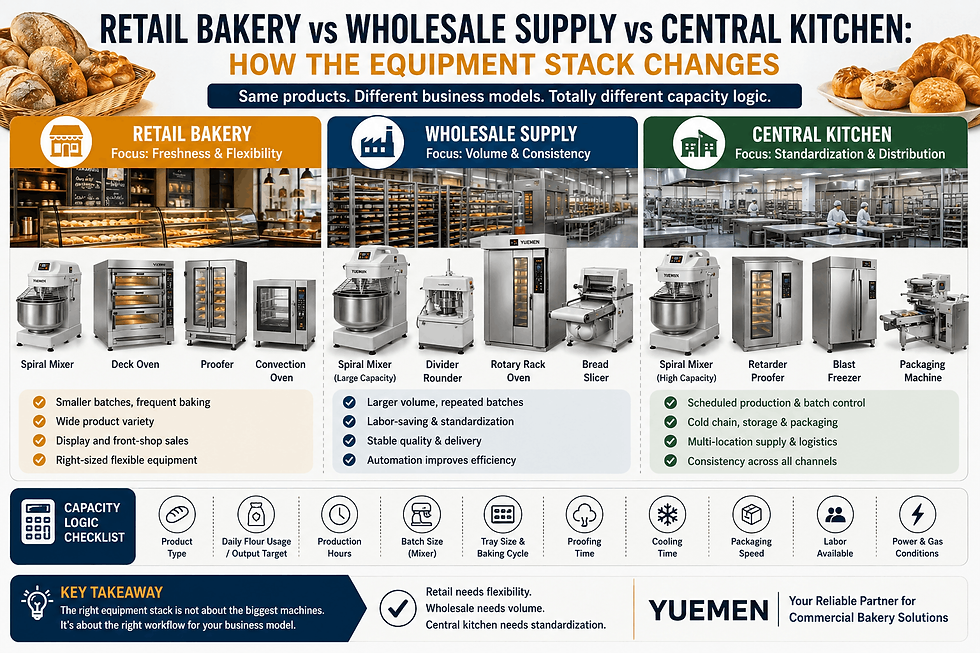
The Main Difference Is Production Logic
Bakery equipment planning should not begin with machine size alone. It should begin with the way the business makes money.
A retail bakery makes money from freshness, variety, display, and daily customer traffic.
A wholesale bakery makes money from stable volume, consistent product weight, controlled labor cost, and reliable delivery.
A central kitchen makes money from standardization, scheduled production, cold-chain control, and the ability to supply multiple stores or channels.
That is why the same bread, bun, croissant, or cake can require a different equipment stack.
Business Model | Main Goal | Production Style | Equipment Priority | Main Risk |
Retail bakery | Fresh daily sales and product variety | Smaller batches, frequent baking | Flexible ovens, mixers, proofers, display and finishing equipment | Buying oversized machines too early |
Wholesale supply | Stable bulk output for external customers | Repeated batches and larger volume | Larger mixers, dividers, moulders, rotary ovens, slicers, packaging | Underestimating labor and consistency |
Central kitchen | Supply multiple stores or sales channels | Scheduled batch production, storage, distribution | Production line, retarder proofer, refrigeration, packaging, logistics support | Ignoring cold chain and workflow control |
For buyers still comparing equipment categories, Yuemen’s commercial bakery equipment page gives a broader view of ovens, mixers, proofers, dough processing machines, and bakery workflow equipment.
Retail Bakery Equipment Is Built Around Freshness and Flexibility
A retail bakery sells directly to customers. The production plan usually includes many products in smaller quantities, such as bread, buns, toast, cakes, pastries, cookies, pizza, and seasonal items.
The equipment does not need to maximize only one product. It needs to support variety.
A retail bakery often bakes several times during the day to keep products fresh. This means flexibility can be more important than maximum theoretical output.
Typical Retail Bakery Buyers
Retail bakery equipment is suitable for:
Bakery shops
Café bakeries
Pastry shops
Hotel bakery rooms
Restaurant bakery corners
Boutique bread shops
Small supermarket bakery sections
Recommended Retail Bakery Equipment Stack
Equipment | Role in Retail Bakery |
Spiral mixer | For bread, buns, toast, pizza dough, and soft dough products |
Planetary mixer | For cakes, cream, fillings, cookies, and batter |
Deck oven | Flexible baking for bread, pizza, pastries, and cakes |
Convection oven | Useful for cookies, pastries, cakes, and frozen bakery items |
Cabinet proofer | Supports daily bread and bun fermentation |
Dough sheeter | Useful for croissants, puff pastry, pizza bases, and laminated dough |
Bread slicer | Add-on for toast and sandwich bread |
Display showcase | Helps convert finished products into front-shop sales |
Tray racks and baking trays | Basic support for production movement and cooling |
A retail bakery does not always need the largest oven. A smaller but flexible oven may be more practical if the shop produces different SKUs throughout the day.
For example, a 3-deck 9-tray gas deck oven can support bread, pastries, cakes, and pizza-style products while keeping production flexible. For pastry, cookies, and cake production, a commercial electric convection oven can be a useful part of the equipment mix.
Retail Bakery Capacity Logic
Retail bakery capacity should be planned by product mix, not only by maximum machine output.
A retail bakery may produce:
Bread in the morning
Cakes and pastries before lunch
Pizza or snacks in the afternoon
Fresh bread again in the evening
In this case, daily production hours and baking frequency matter more than one single large batch.
A practical retail bakery equipment stack should answer:
How many products will be made daily?
Which products need proofing?
Which products need high heat?
Which products need steam?
Which products need display?
How many baking rounds will happen per day?
How much space is available for mixing, proofing, baking, cooling, and selling?
If the shop is still testing local demand, it is usually safer to start with flexible core equipment instead of large industrial machines.
Wholesale Bakery Equipment Is Built Around Output and Consistency
A wholesale bakery does not depend on walk-in customers. It supplies bread, buns, toast, cakes, pastries, or frozen bakery products to other businesses.
Typical customers include supermarkets, cafés, restaurants, schools, hotels, institutions, food distributors, and convenience stores.
The buying logic is different from retail bakery. A wholesale customer cares about stable product size, stable color, stable weight, stable delivery, and stable price.
That means the equipment stack must reduce manual variation.
Typical Wholesale Bakery Buyers
Wholesale bakery equipment is suitable for:
Bread factories
Bun suppliers
Toast and sandwich bread producers
Supermarket bakery suppliers
Restaurant chain suppliers
Frozen bakery producers
Foodservice distributors
Institutional food suppliers
Recommended Wholesale Bakery Equipment Stack
Equipment | Role in Wholesale Bakery |
Large spiral mixer | Handles repeated dough batches and larger flour usage |
Dough divider | Controls dough weight and reduces manual cutting |
Dough rounder | Improves dough shape and consistency |
Dough moulder | Supports toast, baguette, loaf, and roll shaping |
Intermediate proofer | Helps continuous dough processing |
Trolley proofer | Matches rack-based production flow |
Rotary rack oven | Supports larger and more even batch production |
Bread slicer | Required for toast, sandwich bread, and packaged bread |
Cooling rack | Prevents packaging problems caused by residual heat |
Packaging machine | Supports delivery, shelf life, and brand consistency |
For wholesale bread or bun production, a dough divider or divider rounder is often more important than buyers first expect. Manual dividing may be acceptable at small scale, but it becomes a bottleneck when daily output increases.
Yuemen’s semi-auto 26-piece dough divider rounder is suitable for bakeries that want more consistent dough portions without moving directly into a full automatic line. For larger production needs, a bakery volumetric dough divider machine is more suitable for continuous output planning.
Wholesale Bakery Capacity Logic
Wholesale bakery capacity should be calculated by daily output target and production window.
The key questions are:
How many pieces are needed per day?
What is the dough weight per piece?
How much flour is used daily?
How many hours are available for production?
What is the mixer batch size?
What is the divider speed?
How long is proofing?
How long is baking?
How long is cooling?
What time must delivery leave the factory?
A common mistake is to calculate capacity only by oven size.
That is not enough.
A large oven cannot solve a weak mixing, dividing, proofing, cooling, or packaging process. In many wholesale bakeries, the real bottleneck is not the oven. It may be labor, dough handling, proofing space, cooling time, or packaging speed.
Central Kitchen Equipment Is Built Around Standardization and Distribution
A bakery central kitchen is not just a bigger bakery. It is a production and supply system.
It may supply multiple retail stores, supermarket branches, restaurant outlets, hotel kitchens, franchise shops, online channels, or foodservice distributors.
Because of this, the equipment stack must support more than baking. It must support scheduling, storage, packaging, cold-chain control, and delivery.
Typical Central Kitchen Buyers
Central kitchen bakery equipment is suitable for:
Chain bakery brands
Supermarket groups
Restaurant groups
Hotel groups
Franchise bakery operators
Food factories with multi-channel sales
Cloud kitchen operators
Frozen or semi-finished bakery suppliers
Recommended Central Kitchen Equipment Stack
Equipment | Role in Central Kitchen |
Large spiral mixer | Main dough preparation |
Planetary mixer | Cake, filling, cream, and batter production |
Dough divider and rounder | Standardizes dough weight and shape |
Dough sheeter | Supports croissant, puff pastry, pizza, and flat dough |
Retarder proofer | Controls fermentation schedule and labor timing |
Rotary rack oven or tunnel oven | Supports larger and more consistent baking output |
Blast freezer or freezer | Supports frozen or semi-finished bakery products |
Cold storage | Holds ingredients, dough, semi-finished goods, and finished products |
Packaging equipment | Supports delivery, shelf life, and brand consistency |
Stainless steel workflow equipment | Improves hygiene, cooling, sorting, and handling |
A central kitchen may not bake every product to final form. Some products may be delivered as chilled dough, frozen dough, par-baked products, or finished bakery items. That decision changes the equipment stack.
For example, a central kitchen supplying multiple stores with semi-finished dough may need more refrigeration and retarder proofing capacity than a normal retail bakery.
A commercial bakery spray proofer can support controlled fermentation in smaller and medium production setups. For larger central kitchen planning, buyers usually need a more complete proofing, refrigeration, rack, and workflow plan.
Central Kitchen Capacity Logic
Central kitchen capacity should be planned by delivery schedule, not only by baking capacity.
Important questions include:
How many stores or channels need daily supply?
What products are baked fresh?
What products are chilled, frozen, or semi-finished?
What time must each outlet receive goods?
How much buffer stock is required?
Is production done overnight or during the day?
Does the outlet need final proofing or final baking?
Does the system require refrigerated transport?
How much space is needed for cooling, packing, and dispatch?
This is where many bakery projects make mistakes. They buy ovens and mixers first, then later discover that storage, cooling, packing, or delivery is the real limitation.
For supermarket-related projects, Yuemen’s guide on supermarket bakery equipment is a useful related reference because supermarket bakery planning also depends heavily on consistency, low waste, and stable workflow.
Same Product, Different Equipment Stack
The product name alone does not decide the equipment list. The sales model changes the production logic.
Here is a practical comparison.
Product | Retail Bakery | Wholesale Supply | Central Kitchen |
Soft bread | Spiral mixer, deck oven, cabinet proofer, slicer | Large mixer, divider, moulder, rotary oven, slicer, packaging | Production line, retarder proofer, rotary oven, cooling, packaging, delivery control |
Buns and rolls | Mixer, manual divider or divider rounder, deck oven | Divider rounder, trolley proofer, rotary oven, packaging | Standardized dough processing, chilled or frozen supply, multi-outlet delivery |
Croissant | Planetary mixer, sheeter, convection oven, retarder proofer | Large sheeter, retarder proofer, rack oven, freezing support | Frozen or par-baked workflow, blast freezing, cold chain |
Pizza base | Spiral mixer, dough divider, dough sheeter, deck oven | Divider, sheeter, conveyor or rotary baking | Central dough production, chilled dough balls, or pre-baked bases |
Cakes | Planetary mixer, convection oven, display showcase | Larger mixer, convection oven, packaging | Batter production, blast chilling, packaging, refrigerated delivery |
A retail bakery needs flexibility. A wholesale bakery needs repeatability. A central kitchen needs standardization and supply control. That is the core difference.
How to Calculate Bakery Equipment Capacity Correctly
A simple capacity formula looks like this:
Daily output = output per batch × number of batches per hour × production hours
This formula is useful, but it is not enough.
Real bakery production also includes mixing, resting, dividing, rounding, shaping, proofing, baking, cooling, slicing, packaging, and delivery. If one process is too slow, the whole line slows down.
Before choosing equipment, buyers should confirm:
Product type
Dough weight or finished product weight
Target daily quantity
Daily production hours
Mixer batch size
Tray size
Number of trays per bake
Baking cycle time
Proofing time
Cooling time
Packaging speed
Labor available
For example, two bakeries may both produce 1,000 buns per day.
The first bakery produces them across 10 hours for retail sales. It may use a smaller oven and bake in multiple rounds.
The second bakery must finish 1,000 buns before 7 a.m. for wholesale delivery. It needs a stronger mixer, faster dividing, larger proofing capacity, and more organized cooling and packing space.
The output number is the same. The equipment logic is different.
Equipment Stack by Business Stage
Business stage also matters. A new retail bakery, a growing wholesale supplier, and a mature central kitchen should not buy equipment with the same logic.
Stage | Retail Bakery | Wholesale Supply | Central Kitchen |
Starter | Deck oven, mixer, proofer, sheeter, slicer | Mixer, divider, proofer, deck oven or small rotary oven | Usually not recommended unless demand is confirmed |
Growth | Add convection oven, dough divider rounder, display, refrigeration | Add moulder, larger mixer, trolley proofer, slicer, packaging | Build controlled workflow with retarder proofer and cold storage |
Mature | Multi-oven setup, better display, semi-automation | Rotary oven, divider line, cooling, packaging system | Full production line, freezing, packaging, route-based delivery planning |
A retail bakery grows by improving product variety, freshness, and shop conversion. A wholesale bakery grows by improving output per labor hour. A central kitchen grows by improving standardization, storage, and delivery control.
Common Mistakes When Choosing Bakery Equipment
Mistake 1: Choosing Equipment Only by Product Name
“I want to make bread” is not enough information. A retail bakery and a wholesale bread supplier both make bread, but they do not need the same equipment stack. Product type must be combined with output target, working hours, sales channel, labor condition, and delivery requirement.
Mistake 2: Oversizing the Oven but Undersizing Dough Preparation
Many buyers focus on the oven first because it is the most visible machine. But a large oven becomes useless if the mixer, divider, proofer, cooling rack, or packaging process cannot keep up. The best equipment stack should be balanced.
Mistake 3: Ignoring Daily Production Hours
A bakery producing 1,000 pieces in 4 hours needs a different setup from a bakery producing 1,000 pieces across 10 hours. Daily output alone does not define capacity. Production time is just as important.
Mistake 4: Forgetting Storage and Delivery
This is especially risky for central kitchens. A project can have enough baking capacity but still fail because there is not enough cooling space, freezer space, packaging space, or delivery control.
Mistake 5: Copying Another Bakery’s Setup
A successful bakery equipment stack depends on product mix, power supply, labor cost, workshop space, sales channel, budget, and future expansion plan. Copying another bakery may look safe, but it often creates hidden mismatch.
How Yuemen Helps Buyers Plan the Right Equipment Stack
Yuemen does not recommend the same equipment list for every bakery buyer.
A retail bakery, wholesale bakery, and central kitchen may produce similar products, but their workflow and capacity logic are different. That is why we help buyers compare equipment based on real production conditions, not only catalog models.
Yuemen can help plan equipment for:
Retail bakery shops
Café bakeries
Pastry production
Supermarket bakery sections
Wholesale bread and bun suppliers
Commercial bakery factories
Central kitchen bakery projects
Distributor and importer product lineups
Our equipment range includes bakery ovens, spiral mixers, planetary mixers, proofers, dough sheeters, dough dividers, divider rounders, slicers, racks, trays, refrigeration equipment, and complete bakery workflow solutions.
For buyers comparing supply models, Yuemen’s OEM/ODM commercial baking equipment page can also help explain private label, distributor cooperation, and long-term supply planning.
Before recommending a final equipment stack, we usually ask for:
Main product type
Daily flour usage or target output
Daily production hours
Business model
Available space
Voltage and phase
Gas or electric preference
Labor situation
Budget range
Expansion plan
These details decide whether the buyer should choose a flexible retail bakery setup, a higher-output wholesale production setup, or a central kitchen system with storage and delivery planning.
Final Thoughts
The same bakery product can require three very different equipment plans.
A retail bakery needs flexibility and freshness.
A wholesale bakery needs output and consistency.
A central kitchen needs standardization, storage, and distribution control.
Before choosing bakery equipment, do not only ask what product you want to make. Ask how the product will be produced, sold, stored, and delivered every day.
That is the real starting point for a practical bakery equipment plan.
FAQ
What is the main difference between retail bakery equipment and wholesale bakery equipment?
Retail bakery equipment focuses on flexibility, freshness, and product variety. Wholesale bakery equipment focuses on higher output, consistent product size, labor reduction, and reliable delivery schedules.
What equipment does a bakery central kitchen need?
A bakery central kitchen usually needs mixers, dough dividers, dough sheeters, proofers, retarder proofers, rotary ovens or tunnel ovens, refrigeration, cold storage, cooling racks, packaging equipment, and logistics support.
Can a retail bakery use wholesale bakery equipment?
Yes, but only when its daily output, space, power supply, labor structure, and sales volume justify the investment. Oversized equipment can increase cost without improving profit.
Why does the same bakery product need different equipment in different business models?
The same product can have different batch size, delivery timing, labor needs, storage requirements, and quality-control standards. That is why business model matters as much as product type.
How should bakery equipment capacity be calculated?
Bakery equipment capacity should be calculated by product weight, target daily output, daily production hours, mixer batch size, tray size, baking cycle, proofing time, cooling time, packaging speed, and labor availability.
What information should I provide before asking for a bakery equipment quotation?
You should provide your product type, daily output target, daily production hours, voltage, gas or electric preference, available space, destination country, and whether the project is for retail bakery, wholesale supply, or central kitchen production.
Planning a bakery project?
Send Yuemen your product type, target daily output, daily production hours, voltage, gas preference, and business model. We can help you compare the right equipment stack for a retail bakery, wholesale bakery, or central kitchen project.