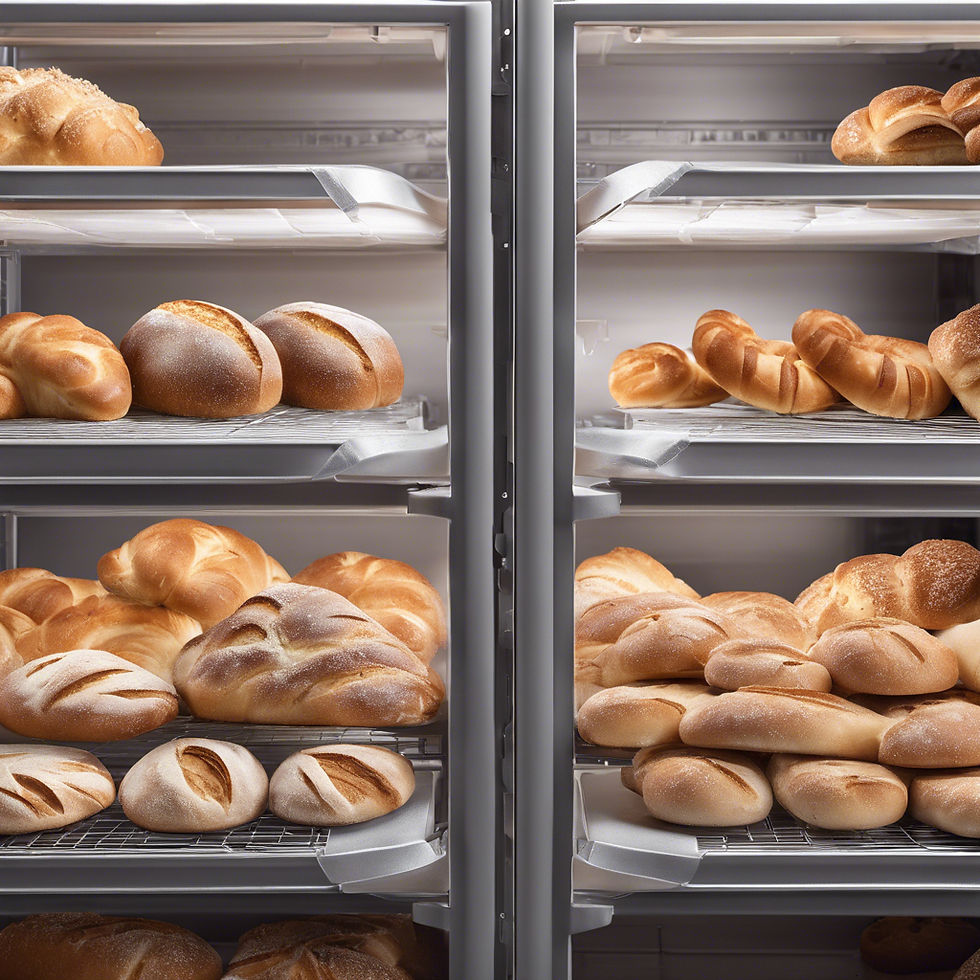
Refrigerated Dough Proofer for Small Bakeries | Boost Bread Quality & Save Time
- Yina Huang
- Aug 6, 2025
- 4 min read

Why Bakery Growth Depends on Controlled Fermentation
If you're baking bread, you're managing time and fermentation—whether you realise it or not.
In a small bakery producing 200–600 loaves per day, relying on ambient proofing or overnight refrigeration becomes a bottleneck. One hour of overproofing can ruin an entire batch. Early fermentation can force you to bake too soon. This lack of control leads to wasted dough, irregular crumb texture, and inconsistent crust formation.
That’s where the refrigerated dough proofer steps in.
By combining programmable retardation (cold storage) with timed proofing (warm, humid conditions), a refrigerated bread proofer gives you industrial-level precision in a compact unit—perfect for small or medium-sized bakeries aiming to scale without adding labour or overnight shifts.
Case in Point:A 36-tray refrigerated proofer allows a bakery in Nairobi to prepare 600 baguettes and croissants the night before. Staff arrive at 6 AM, and proofing is already complete by 7:15 AM—ready to bake. No night shift. Zero wasted dough.

What Is a Refrigerated Dough Proofer?
A refrigerated dough proofer (also known as a retarder proofer) is a programmable, insulated cabinet that:
Keeps dough cold (2–6°C) to delay fermentation (retardation phase)
Automatically shifts to warm/humid proofing (30–40°C, 70–90% RH)
Allows bakers to schedule baking cycles in advance
It replaces the need for separate refrigeration and proofing units, saving space, energy, and labour while improving dough consistency and timing.
Most compact models fit 18 trays (for up to 250 buns or 200 loaves) Larger models go up to 64 trays (up to 1000 buns or 750 loaves daily) Temperature precision is typically within ±1°C Retardation time can be set from 2 to 24 hours Power usage: 2.5–4 kW depending on size and insulation quality
Why Choose a Refrigerated Bread Proofer?
1. Batch Consistency
Precise control of temperature and humidity improves gluten structure, volume, and oven spring. Perfect for sourdough, baguettes, milk buns, croissants, and more.
2. No Night Shifts Required
Set the machine at 9 PM. The next morning, your dough is proofed and ready to bake automatically.
3. Reduced Waste
By eliminating overproofing and mistimed baking, you avoid throwing away expensive flour, butter, and time.
4. Better Scheduling
Proofing becomes predictable, allowing bakeries to align output with retail traffic or delivery schedules.
5. Scalability
A single 36-tray refrigerated dough proofer can support production increases of up to 300%, especially for products like toast loaves and breakfast buns.
Example Setup: A Ghanaian bakery uses one 64-tray unit to supply four shops with 1000 loaves every morning. They prepare dough in the afternoon, load the proofer at 8 PM, and bake at 6 AM.
Key Features to Look For
Feature | Why It Matters |
Tray Capacity | Common options: 16, 36, or 64 trays; choose based on daily volume |
Programmable Timer | Automates the transition from cold to warm phases |
Humidity System | Prevents surface drying and crusting during proof |
Stainless Steel Build | Hygiene, easy cleaning, and long lifespan |
Energy Efficiency | Check insulation and fan cycling to avoid heat loss |
How to Use a Refrigerated Dough Proofer Effectively
Calculate Backward: If you want buns ready by 6 AM, schedule proofing to start by 4:30 AM. Set retardation to hold dough from 9 PM to 4 AM.
Monitor Dough Weight & Hydration: Wetter doughs benefit more from consistent humidity. A 60–65% hydration dough proofs best around 85% RH.
Rotate Shelves Weekly: Helps reduce tray warping and ensures balanced airflow.
Clean Water Trays Weekly: Prevent limescale buildup and bacteria.
Calibrate Every 6 Months: Use a digital thermometer and hygrometer to confirm accuracy.
5 Common Misconceptions About Refrigerated Dough Proofers
Myth 1: “This is only for large bakeries.”
Reality: Even a 16-tray unit supports 150–200 loaves daily—ideal for start-ups and boutique bakeries. Small proofer models are designed for shops under 80 sqm.
Myth 2: “I can just use a fridge + regular proofer.”
Reality: That setup requires manual transfer, which introduces timing errors and temperature shock, often ruining fermentation curves.
Myth 3: “They’re too expensive for small operations.”
Reality: Entry-level refrigerated proofers start under $1,800 FOB. Considering the labour and ingredient savings, ROI can be reached in under 12 months.
Myth 4: “Cold fermentation ruins the dough.”
Reality: Controlled retardation enhances flavour by slowing enzymatic activity and allowing natural sugar development. It’s essential for sourdough, croissants, and brioche.
Myth 5: “Cleaning and maintenance are a hassle.”
Reality: Most modern models have accessible humidifiers and stainless steel interiors. A 5-minute daily wipe and weekly descaling are sufficient for peak performance.
Conclusion: Control the Clock, Master the Crumb
If you're aiming to scale up production, cut labour costs, or perfect your fermentation schedule, the refrigerated dough proofer is one of the smartest investments for your bakery.
From precision timing to overnight convenience, it helps your team deliver perfect loaves and pastries—on time, every time.
Whether you're baking 200 toast loaves or 500 croissants per day, this machine transforms your kitchen into a precision baking hub.
Your Bakery’s Upgrade Starts Here
Yuemen Baking Equipment, located in Guangzhou, China, supplies high-performance refrigerated bread proofers tailored for growing bakeries worldwide. From compact 16-tray units to 64-tray industrial options, we help you find the right match.
📩 Contact: Kian Huang📧
Email: kian.huang@yuementrading.com
📱 Phone/WhatsApp: +86 18819459649
Let’s build your bakery's future—starting with better fermentation.